Spec Battle: Seagate Exos Mozaic M 30Tb Hard Drive vs Ugreen M571 Wireless Vertical Mouse — Is It Worth Upgrading?
Category: Laptops
Introduction
Upgrading a laptop setup often forces consumers to choose between vastly different categories of hardware. One upgrade is dramatic and invisible: bulk storage that changes what can be stored, archived, or served. The other is intimate and tactile: an ergonomic peripheral that changes how the user interacts with the machine. This article places the Seagate Exos Mozaic M 30Tb hard drive and the Ugreen M571 wireless vertical mouse side-by-side in a practical "spec battle" to answer the question many buyers secretly have — is it worth upgrading either, or both?
The Seagate Exos Mozaic M 30Tb hard drive is a headline-grabbing capacity upgrade aimed at users and organizations needing huge, cost-effective storage. The Ugreen M571 wireless vertical mouse promises ergonomic relief for users who spend long hours at a laptop and want to limit wrist strain. These products serve different needs, so the comparison focuses on value, impact on everyday workflows, and which buyer profiles benefit most from each upgrade.
Product analysis and real-world context
Seagate Exos Mozaic M 30Tb Hard Drive — what it delivers
The Seagate Exos Mozaic M 30Tb is positioned as a very-high-capacity drive for users who prioritize raw storage density over instantaneous snappy performance. Drives at this capacity target use cases such as network-attached storage (NAS), archive servers, media libraries, and cold or mixed storage tiers in small businesses and creative studios. Typical buyers are content houses with large video files, photographers with multi-year RAW archives, researchers keeping terabytes of datasets, and home-lab enthusiasts consolidating many drives.
Real-world buyers care about several practical attributes beyond raw terabytes: the drive interface and compatibility (is it SATA, SAS, or requires a specialized enclosure), the required form factor (most high-capacity drives are 3.5" and need a powered enclosure or desktop NAS), heat and noise in everyday operation, power consumption (important for 24/7 deployments), and long-term reliability. For many, warranty length and Seagate's track record with enterprise-class products also factor into the purchase decision.
When integrated into a laptop workflow, a drive like this usually doesn't sit inside the laptop itself; instead it becomes part of an external storage strategy — a desktop external drive, NAS accessible over the network, or a direct-attached storage (DAS) chassis connected over USB or Thunderbolt. That means the actual upgrade experience includes enclosure costs and potential logistics (rack space, UPS, network configuration), but it also unlocks capacities that dramatically change what projects a laptop user can store and share without relying on cloud services.
Ugreen M571 Wireless Vertical Mouse — what it delivers
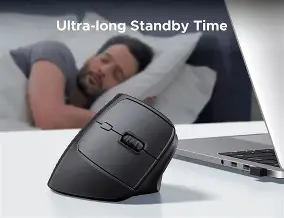
The Ugreen M571 targets individuals who feel discomfort, stiffness, or cumulative strain from traditional flat mice. Vertical mice rotate the hand into a handshake position, which places the wrist and forearm in a different alignment and can reduce pronation — a common source of discomfort for heavy laptop users, designers, office workers, and developers.
Discover deals on Laptops & Computers — updated daily.
Shop Amazon →Buyers typically focus on ergonomics, build quality, button layout, tracking reliability, connectivity (Bluetooth and/or 2.4GHz dongle), battery life, and compatibility with existing laptop setups. For laptop users who move between desks, the mouse's portability, ability to pair to multiple devices, and ease of switching are important. For those with repetitive stress symptoms or those looking to prevent them, perceived comfort and adjustability are major buying drivers.

In practical usage, a vertical mouse like the M571 shifts daily comfort more than raw productivity. For users who do long editing sessions, coding sprints, or spreadsheet-heavy work, a comfortable mouse can reduce interruptions and fatigue — effectively increasing productive time and lowering the risk of discomfort-related breaks.
Detailed review — strengths and caveats
Seagate Exos Mozaic M 30Tb — strengths
- Massive storage density: Offers a single-volume solution to store large media libraries, backups, or datasets, reducing the number of drive units to manage.
- Cost-per-terabyte efficiency: High-capacity drives generally lower the total cost-per-GB compared to many SSD solutions, making them attractive for archival purposes.
- Good for sequential workloads: Ideal for streaming large files, backups, and archive retrieval where sequential throughput matters more than random IOPS.
- Scalable in multi-drive systems: Easy to incorporate into NAS arrays or backup towers to increase usable capacity.
Seagate Exos Mozaic M 30Tb — caveats
- Not a laptop internal upgrade: The physical size and interface typically mean this is an external or rack-mounted addition rather than a direct laptop replacement.
- Lower random-access performance: Compared to NVMe and SATA SSDs, large-capacity HDDs provide significantly lower IOPS, which affects OS-level tasks and workflows that rely on many small, random reads/writes.
- Power, heat, and noise: Continuous operation can generate heat and audible noise in an office environment; attention to enclosure cooling and placement matters.
- Lifecycle considerations: A single-drive failure at high capacity means larger potential data loss unless redundancy (RAID, replication) is used.
Ugreen M571 Wireless Vertical Mouse — strengths
- Ergonomic design: Rotated grip reduces wrist pronation and can ease discomfort for many users during long sessions.
- Wireless convenience: Typically supports both Bluetooth and USB receiver modes, allowing flexible pairing with laptops and tablets.
- Improves daily comfort: A small, relatively inexpensive change that often yields immediate, noticeable ergonomic benefits.
- Battery-life focus: Many wireless vertical mice are engineered for long battery life, minimizing downtime.
Ugreen M571 Wireless Vertical Mouse — caveats
- Learning curve: Users accustomed to standard mice may need a few days to adapt to the vertical grip and button placement.
- Not ideal for all gamers: Vertical mice prioritize comfort, which can trade off on low-latency fine-grain control preferred in competitive gaming.
- Size and fit: Ergonomics are personal — what fits one hand well might be awkward for another, so testing when possible is valuable.
Comparison — how these upgrades affect laptop users
| Aspect | Seagate Exos Mozaic M 30Tb | Ugreen M571 Wireless Vertical Mouse |
|---|---|---|
| Primary benefit | Massive local storage; reduced reliance on cloud or multiple drives | Ergonomic comfort; reduced wrist strain during extended use |
| Impact on laptop performance | Indirect — enables storing/serving large files but not faster application responsiveness | Direct on user comfort and productivity; no impact on compute or IO |
| Compatibility | Requires appropriate enclosure/NAS, verify interface and form factor | Works with most laptops via Bluetooth or a USB receiver |
| Installation complexity | Moderate to high — possibly requires NAS setup or enclosure purchase | Low — plug-and-play for most setups |
| Best for | Media professionals, home servers, backup-centric users, small studios | Office workers, developers, designers, anyone seeking ergonomic relief |
| Cost vs. benefit | High upfront cost but good long-term storage economics | Low to moderate cost with immediate comfort benefits |
Buying guide — which upgrade is right and when
Choosing between a high-capacity hard drive and an ergonomic mouse is not an either-or decision for many users — they solve different problems. The following guidance helps prioritize based on use-case, budget, and immediate needs.
When to prioritize the Seagate Exos Mozaic M 30Tb
- Large media workflows: If editing multi-hour 4K/8K footage or managing raw photo libraries where local storage speeds up project access and reduces cloud egress costs, a high-capacity drive is transformative.
- Local backup and archive needs: Users who must keep long retention backups locally (for compliance, privacy, or offline access) will benefit from consolidating onto a single high-density volume.
- Small business or home server: When operating a NAS for multiple users or services, higher-capacity drives reduce the number of bays occupied and may simplify management.
- Cost-per-terabyte is a top metric: If the priority is to maximize raw storage for the budget rather than maximize speed, HDDs deliver better economics than SSDs.
When to prioritize the Ugreen M571 Wireless Vertical Mouse
- Long hours of mouse use: If the laptop is used for lengthy editing sessions, coding, or spreadsheet work, investing in ergonomics directly improves daily comfort and productivity.
- Symptoms of strain: Early signs of wrist discomfort, tingling, or fatigue can justify a switch to a vertical mouse as a low-risk ergonomic intervention.
- Low budget, high impact: If immediate improvement in daily comfort is the goal and budget is limited, a vertical mouse is an efficient upgrade.
- Frequent device switching: Users who pair a single peripheral with multiple laptops will value ease of pairing and multiple connectivity modes.
Practical considerations before buying
- Confirm interfaces and enclosures: For a 30TB drive, check whether the drive requires SATA, SAS, or a specific enclosure. If using with a laptop, plan for a powered external enclosure or NAS and the associated costs.
- Think redundancy: High-capacity single drives are efficient but increase the stakes of a single-drive failure. Budget for redundancy (RAID, replication, cloud backup) if data loss is unacceptable.
- Test ergonomics if possible: Try a vertical mouse before committing if local retailers allow testing; hand size and grip style matter.
- Consider total cost of ownership: Include power, cooling, enclosure, and management time for large drives; include replacement batteries or charging solutions for the mouse.
Real-world scenarios and recommendations
Below are composed scenarios reflecting typical buyers and which upgrade makes the most sense.
Scenario A: Freelance video editor
Needs: fast access to large project files, frequent local editing sessions, also often works remotely on a laptop.
- Recommendation: Prioritize the Seagate Exos Mozaic M 30Tb as backend storage in a NAS or desktop DAS. Use fast external SSDs or the laptop's internal SSD for active projects and keep long-term assets on the large drive. Consider the Ugreen M571 as a secondary, lower-cost upgrade if wrist fatigue becomes noticeable.
Scenario B: Office professional and spreadsheet power user
Needs: long daily sessions on a laptop, many repetitive mouse actions, limited need for large local storage.
Shop the latest Laptops & Computers picks on Amazon.
See Deals →- Recommendation: Prioritize the Ugreen M571. The immediate ergonomic benefits will likely outweigh the limited value of adding very large capacity storage, which this user doesn't need.
Scenario C: Home lab or small business admin
Needs: centralized backups, occasional remote access from laptops, cost-effective long-term storage.
- Recommendation: Prioritize the Seagate Exos Mozaic M 30Tb and incorporate it into a redundant NAS array. The mouse is a secondary choice and can be acquired later if ergonomics become a daily issue.
Pros & cons (summary)
Seagate Exos Mozaic M 30Tb — pros & cons
- Pros: Extremely high capacity in a single drive, efficient cost per TB for archival storage, useful for NAS and archive workflows.
- Cons: Not directly installable in most laptops; requires enclosure or NAS, higher complexity, lower random performance than SSDs, increased single-point-of-failure risk without redundancy.
Ugreen M571 Wireless Vertical Mouse — pros & cons
- Pros: Improves comfort and reduces wrist pronation, simple plug-and-play upgrade, relatively low cost, portable and easy to pair with laptops.
- Cons: Learning curve for some users, may be less suitable for certain fast-paced gaming, ergonomics are subjective.
Conclusion
Choosing between the Seagate Exos Mozaic M 30Tb hard drive and the Ugreen M571 wireless vertical mouse depends entirely on the problem the buyer wants to solve. The hard drive is a strategic infrastructure purchase: it changes what can be stored and served, and it unlocks workflows that require local, high-capacity storage. The vertical mouse is a tactical, human-centered upgrade: it changes the daily experience of using a laptop and can directly reduce discomfort and lost productivity due to fatigue.
For creative professionals and small businesses facing storage limits, the 30Tb drive is likely the more transformative upgrade — provided the buyer is prepared for the enclosure, redundancy, and setup costs. For office-heavy laptop users or anyone experiencing wrist discomfort, the Ugreen M571 is a low-friction, high-impact upgrade that will probably pay for itself quickly in comfort and sustained productivity.
Ultimately, one is not objectively "better" than the other — they serve different ends. If budget allows, both are reasonable upgrades: the drive to expand capability and archive capacity, and the mouse to protect and optimize the user's daily interaction with the laptop. If a choice must be made, align it to what constrains current work most: data capacity or human comfort. Address the constraint first, and the other upgrade can follow as a high-value refinement to the overall setup.